Food-label investigation · US labels checked November 16, 2026
Twenty grams of protein can mean about 189 g of plain Greek yogurt, most of a protein bar, four slices of one bread, or nearly six tablespoons of peanut butter. The protein number alone does not tell you how much food you are comparing.
We transcribed six manufacturers' nutrition labels and calculated the portion that would supply the same 20 g of labeled protein. In this selected group, the energy attached to that amount ranges from 100 to about 543 calories. That is a difference in food composition, not a verdict on which food you should eat.
The useful question is more specific: are you looking for a compact protein source, building a sandwich, adding energy to a meal, or choosing something you can carry? Those jobs can call for different foods.
See the original labels · Compare equal protein · Download the data and method
First, keep the manufacturer's serving visible
A bar, a bottle and a slice are all called one serving. They do not contain the same amount of food or protein. The FDA explains that label serving sizes reflect amounts people typically consume; they are not instructions for how much you personally should eat.
This first table preserves the original unit. Every product name links to the manufacturer's page. Values are for the exact US products listed, without toppings, spreads or other additions.
| Product | Label serving | Protein | Calories | Fiber |
|---|---|---|---|---|
| FAGE Total 0% plain Greek yogurt | 3/4 cup (170 g) | 18 g | 90 | 0 g |
| fairlife Core Power Chocolate 26g | 1 bottle (414 mL) | 26 g | 170 | 2 g |
| Quest Chocolate Chip Cookie Dough bar | 1 bar (60 g) | 21 g | 190 | 12 g |
| Dave's Killer Bread Powerseed | 1 slice (42 g) | 5 g | 90 | 4 g |
| Food for Life Ezekiel 4:9 Original bread | 1 slice (34 g) | 4 g | 80 | 3 g |
| Jif Creamy peanut butter | 2 tbsp (33 g) | 7 g | 190 | 2 g |
The variant matters. The FAGE row uses the tub's 170 g serving, not its 150 g single cup. The fairlife row is the 26 g Core Power chocolate bottle, not Elite. The bread rows use the current nutrition images linked from the product pages. A similar product name in a food database is not enough to establish a match.
Now give every food the same protein target
We chose 20 g as an easy comparison unit. It is not a universal meal target or a recommendation to eat the calculated portion. Multiply each label value by 20 divided by the label's protein grams.
| Product | Amount | Label servings | Calories | Fiber |
|---|---|---|---|---|
| FAGE Total 0% | 189 g | 1.11 | 100 | 0.0 g |
| Core Power Chocolate 26g | 318 mL | 0.77 | 131 | 1.5 g |
| Quest Cookie Dough bar | 57 g | 0.95 | 181 | 11.4 g |
| Dave's Powerseed | 168 g | 4.00 | 360 | 16.0 g |
| Ezekiel 4:9 Original | 170 g | 5.00 | 400 | 15.0 g |
| Jif Creamy | 94 g | 2.86 | 543 | 5.7 g |
Amounts and calories are rounded to whole numbers; fiber is rounded to one decimal. These are calculations from already rounded labels. The displayed precision does not make them laboratory measurements.
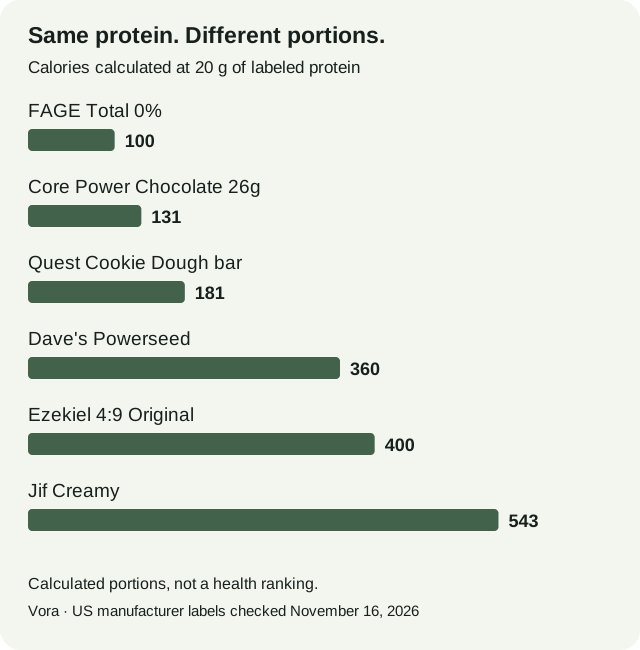
What changes when you look at the portion?
The bar and shake exceed 20 g in their labeled units
The Quest bar lists 21 g; the Core Power bottle lists 26 g. The table therefore uses less than a whole bar or bottle. If you consume the whole item, log the whole label serving: 190 calories for the bar or 170 for the bottle in this snapshot. The normalized table answers a comparison question, not what you actually consumed.
For the FAGE tub, reaching 20 g takes slightly more than its 170 g label serving. A food log that treats every yogurt container as the same size can be wrong before any discussion of protein goals begins.
Bread contributes protein within a meal
Reaching 20 g from these breads alone takes four Powerseed slices or five Ezekiel slices. That does not make either a poor sandwich ingredient. It tells you that two slices contribute 10 g or 8 g of protein, respectively, using these labels.
Two Powerseed slices plus one label serving of Jif add up to 17 g protein, 370 calories and 10 g fiber. Two Ezekiel slices with the same peanut butter add up to 15 g protein, 350 calories and 8 g fiber. Those are arithmetic examples without jam or other ingredients, not prepared or weighed meals. The meal is easier to understand when each contribution stays visible.
Peanut butter has a different protein-to-energy ratio
The Jif label lists 7 g protein per two tablespoons. To reach 20 g through that product alone, the multiplication factor is 20 ÷ 7, or about 2.86. That produces about 94 g of peanut butter and 543 calories.
If your goal for an ingredient is specifically to add protein with relatively little additional energy, that ratio matters. If you also want energy, a spread or a flavor you enjoy, the decision changes. Calling every protein-containing food interchangeable hides that choice.
Fiber changes the comparison, but does not create a winner
The equal-protein portions carry very different fiber quantities. The bread calculations reach 16 g and 15 g because they involve four and five slices. The Quest calculation reaches about 11.4 g in less than one bar. The yogurt label lists none.
Those numbers describe the selected portions. They do not show how filling a food will feel to you, how well you will tolerate it, or whether it supplies everything a meal needs. We did not measure any of those outcomes. Nor did we compare micronutrients, sodium, ingredients, allergies or protein quality in this table.
There is also no price winner here. A defensible price comparison needs a dated retailer, location, pack size and treatment of subscriptions or promotions. Adding an undated price would make this dataset look more complete while making it harder to trust.
Use this comparison without turning meals into a spreadsheet
- Start with the job. Decide whether you are comparing a snack, a spread, a drink or a whole meal. Similar protein totals do not make those experiences interchangeable.
- Match the actual package. Check country, flavor, size and nutrition panel. Product families can contain several formulations.
- Use the amount you ate. If the label says 33 g and your portion is 20 g, multiply every label nutrient by 20 ÷ 33. Do not borrow just the protein number from a larger serving.
- Keep the rest of the meal. Bread, fillings, spreads and drinks all contribute. A headline about one ingredient cannot describe the finished meal.
You can use an equal-weight comparison for a different question. Protein per 100 g is helpful when comparing two yogurts or breads. It is less intuitive when comparing a drink with a dense spread. Keep the denominator next to the number rather than letting it disappear into a claim about the “best” food.
Method, downloads and limits
This is a manually researched label comparison, not a food test. We selected six contrasting examples from dairy, packaged protein products, bread and a spread to show how serving units affect the answer. The sample is not representative of the supermarket, and inclusion does not mean each product makes a regulated “high protein” claim.
We checked manufacturer pages on November 16, 2026, transcribed the relevant nutrition panels, retained the original servings and applied one formula consistently. For the breads, the dataset also includes direct links to the nutrition images we read. The calculation does not adjust for digestibility or differences in amino-acid composition. It does not validate manufacturers' nutrient declarations.
Download: CSV table · JSON with sources and notes. Vora permits reuse of our original calculations and compilation with attribution to this article and the manufacturer sources. Third-party packaging, trademarks and other manufacturer material are excluded.
Check your package if its label differs. Reformulations, regional products and older stock can make a current website an imperfect match for the food in your hand. Send corrections with the product, country and label details to support@askvora.com; see our editorial standards.
From one food label to your own routine
Publisher disclosure: we make Vora. Vora brings proactive AI together with nutrition, workouts and connected wearable context. This investigation is useful on its own; using Vora is optional. If you want help keeping food information alongside the rest of your health routine, explore how text-based logging works and check the setup and supported channels before starting.